Grass Types for North Texas Lawns: St. Augustine, Bermuda, and Zoysia
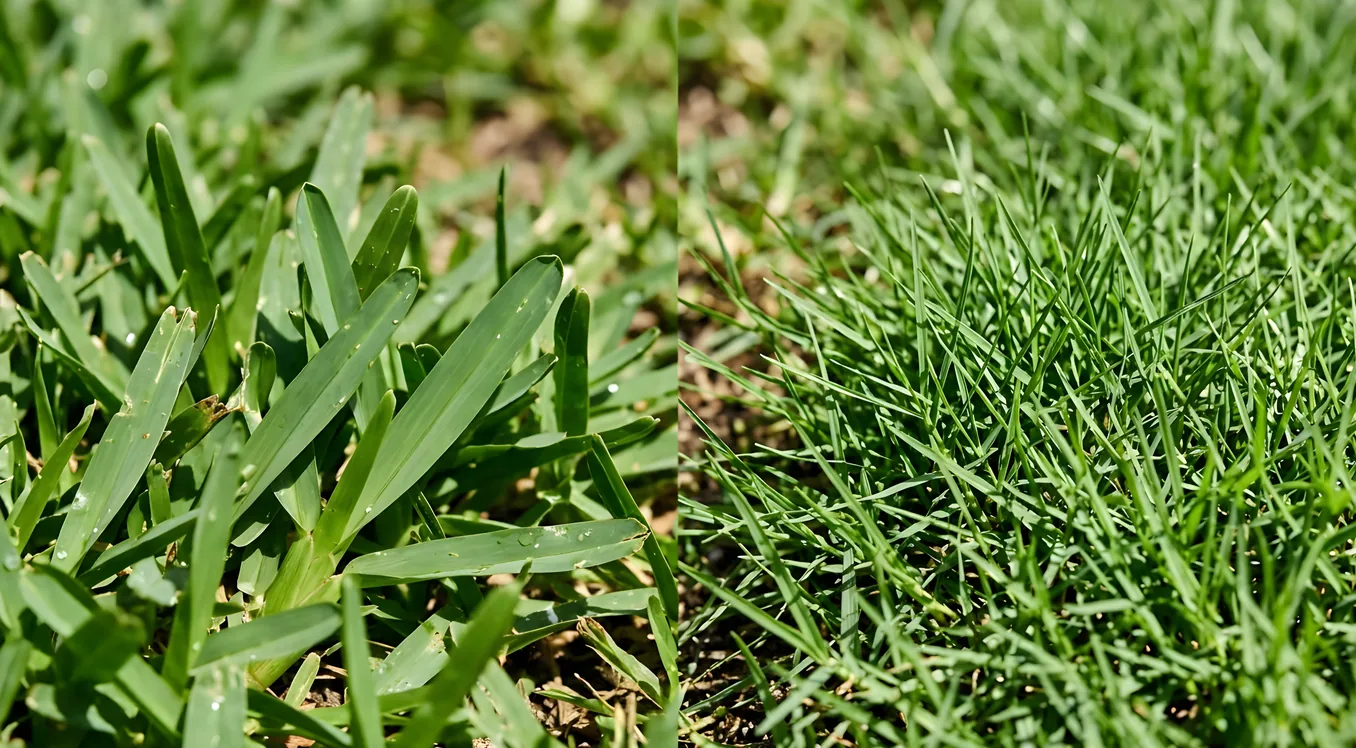
St. Augustinegrass, Bermudagrass, and Zoysiagrass all have Texas A&M AgriLife Extension care guidance for North Texas lawns. St. Augustinegrass and Bermudagrass have dedicated home lawn maintenance calendars with fertilizing detail, so this guide, part of the Little Elm Lawn Guide, covers those two in the most depth. Zoysiagrass has an AggieTurf variety profile covering growth habit, strengths, and mowing.
Bermudagrass is a fine-textured turfgrass that spreads by rhizomes below ground and stolons above ground, and it does best in full sun. St. Augustinegrass spreads laterally by stolons and has notably stronger shade tolerance than other warm-season grasses, per Texas A&M AgriLife's AggieTurf profile. Care does differ by grass type: fertilizing windows, mowing needs, and disease and pest risk aren't identical between species. St. Augustinegrass's problems covered below include the southern chinch bug and brown patch fungus.
St. Augustinegrass in North Texas Yards
St. Augustinegrass is a warm-season turfgrass common in Texas home lawns. Texas A&M AgriLife Extension publishes a maintenance calendar for the species; the sections below cover what that calendar and related pest and disease research document.
What St. Augustinegrass Needs to Grow Well
Texas A&M AgriLife Extension's St. Augustinegrass Home Lawn Maintenance Calendar sets a fertilizing window rather than a single date. It calls for 0.5 to 1 pound of nitrogen per 1,000 square feet, applied one to four times during the growing season with a mix of quick- and slow-release fertilizer, and it caps total nitrogen at 4 pounds per 1,000 square feet per year. The calendar also sets a cutoff: the last nitrogen application should land four to six weeks before the first historic frost. See the fertilizing schedule for the full timing breakdown.
Its Most Common Pest: the Southern Chinch Bug
The southern chinch bug (Blissus insularis) is one of the most important insect pests of St. Augustinegrass in Texas, according to Texas A&M AgriLife Extension's Chinch Bug Management in Lawns. Visible damage tends to show up once a lawn reaches roughly 20 to 25 chinch bugs per square foot.
Brown patch and chinch bug damage can look similar to a homeowner. Brown patch tends to appear in a circular or semi-circular pattern; chinch bug damage is irregular-shaped, per Texas A&M AgriLife.
Brown Patch Disease
Brown patch (Rhizoctonia solani) is one of the diseases Texas A&M AgriLife's Texas Plant Disease Handbook documents on St. Augustinegrass. Patches commonly develop in fall, winter, and spring, when evening temperatures fall below 68°F and rainfall increases. The disease develops fastest between 75°F and 85°F and usually subsides once air temperatures climb above 90°F. See brown patch for identification and management detail beyond the seasonal pattern here.
Bermudagrass in North Texas Yards
Bermudagrass is a warm-season turfgrass with its own AgriLife management calendar.
Strengths and Weaknesses of Bermudagrass
Texas A&M AgriLife Extension's Bermudagrass Home Lawn Management Calendar describes Bermudagrass as a fine-textured turfgrass that spreads laterally below ground by rhizomes and above ground by stolons. The same source lists its strengths as drought tolerance, heat tolerance, deep rooting, durability, recuperative potential, salinity tolerance, rapid establishment, and low disease potential. Its weaknesses: Bermudagrass doesn't tolerate shade well, it needs frequent mowing, and it carries a moderate to high fertilization requirement.
Bermudagrass is "one of the most well-adapted turfgrass species for use in Texas home lawns," per Texas A&M AgriLife Extension.
Mowing Bermudagrass Correctly
Texas A&M AgriLife recommends mowing Bermudagrass home lawns to 1 to 2 inches with a rotary mower, generally on a weekly schedule during the growing season, and never removing more than a third of the leaf tissue in a single cut.
Zoysiagrass in North Texas Yards
Zoysiagrass is a warm-season turfgrass grown in North Texas yards, and it's a search term homeowners use when trying to identify their lawn. Texas A&M AgriLife's AggieTurf Zoysiagrass profile describes it as rhizomatous and stoloniferous, spreading laterally by rhizomes and stolons. Its strengths include shade tolerance, drought tolerance, cold tolerance, and traffic tolerance, with a low fertilization requirement: 1 to 3 pounds of nitrogen per 1,000 square feet per year, applied in single doses of 0.5 to 1 pound during the summer growing season. AggieTurf recommends mowing Zoysiagrass home lawns to 1 to 2 inches with a rotary mower, generally weekly. Its weaknesses include thatch buildup and slow recovery from damage. The comparison table below reflects this AggieTurf profile for growth habit and mowing and fertilizing. This guide doesn't cover pest and disease detail for Zoysiagrass.
Not sure which grass you have, and it doesn't match the traits above? A local lawn care company can usually identify it on sight. Compare options on the Little Elm lawn care directory.
Comparing the Three Grass Types at a Glance
The table below lines up what's documented for each grass type.
| Grass Type | Texture / Spread Habit | Sun Tolerance | Common Pest or Disease | Mowing/Fertilizing Note |
|---|---|---|---|---|
| Bermudagrass | Fine-textured; spreads by rhizomes below ground and stolons above ground | Full sun; doesn't tolerate shade well | Low disease potential overall (no single named pest or disease) | Mow 1-2 in. weekly; 0.5-1 lb N/1,000 sq ft per application |
| St. Augustinegrass | Stoloniferous; spreads laterally by stolons | Full sun to shade; notably shade tolerant relative to other warm-season grasses | Southern chinch bug; brown patch fungus | 0.5-1 lb N/1,000 sq ft, 1-4 times per season; cap 4 lbs N/1,000 sq ft per year |
| Zoysiagrass | Rhizomatous and stoloniferous; spreads laterally by rhizomes and stolons | Shade tolerant, per AggieTurf | Not covered here | Mow 1-2 in. weekly; 1-3 lb N/1,000 sq ft per year |
Matching Your Care Routine to Your Grass Type
Knowing which grass is growing changes when to fertilize and what to watch for during the year. Bermudagrass and St. Augustinegrass follow different nitrogen timing, disease risk, and mowing needs, so a routine built around one doesn't automatically fit the other.
Both AgriLife fertilizing windows land on the same nitrogen rate, 0.5 to 1 pound per 1,000 square feet per application, and both allow 1 to 4 applications per year, but the seasonal cutoff wording differs between the two species: St. Augustinegrass carries an explicit last-application cutoff of 4 to 6 weeks before the first historic frost and a 4-pound annual cap, while Bermudagrass's calendar ties timing to spring green-up and fall dormancy without a matching numeric cap. Check the fertilizing schedule for the specific grass type before the first application of the year.
Soil plays a role too: much of Denton County sits in or near the Grand Prairie and Blackland Prairie region, where clay soils with high shrink-swell properties are common, per USDA-NRCS. That's a county- and region-level pattern, not a confirmation of any single yard's soil. See clay soil for what that documented pattern means for watering and fertilizing.
These fertilizing windows are only part of the year-round picture; the full seasonal care calendar lines up pre-emergent, pest, and disease timing against the same growing season.
Homeowners who'd rather have someone else handle the seasonal schedule can compare Little Elm lawn care companies on the homepage.
Frequently Asked Questions
What is brown patch, and does it affect all grass types?
Brown patch is a fungal disease caused by Rhizoctonia solani. On St. Augustinegrass, Texas A&M AgriLife documents patches developing most often in fall, winter, and spring, when evening temperatures drop below 68°F and rainfall increases, with disease progressing fastest between 75°F and 85°F. This guide doesn't cover brown patch data for Bermudagrass or Zoysiagrass. See the brown patch guide for identification and management help.
What pest should St. Augustinegrass owners watch for?
The southern chinch bug (Blissus insularis) ranks among the most damaging insect pests of St. Augustinegrass in Texas, per Texas A&M AgriLife Extension. Visible lawn damage tends to show up once a lawn reaches around 20 to 25 chinch bugs per square foot. Its damage pattern is irregular-shaped, which helps distinguish it from the more circular patches brown patch fungus leaves behind.
How short should I mow Bermudagrass?
AgriLife's mowing guidance sets Bermudagrass mowing height at 1 to 2 inches, cut with a rotary mower on a generally weekly schedule through the growing season. The same guidance includes a one-third rule: never take off more than a third of the grass blade's length in one pass. Height and frequency are the two levers AgriLife ties to a healthy Bermudagrass home lawn.
Is my North Texas lawn growing in clay soil?
Texas A&M AgriLife and USDA-NRCS data place much of Denton County within or near the Grand Prairie and Blackland Prairie region, an area known for clay soils with high shrink-swell characteristics. That's a documented pattern at the county and region level, not proof about one specific yard. See the clay soil guide for what that regional pattern typically means for watering and fertilizing.