Brown Patch and Other Lawn Fungus: Identification and Treatment
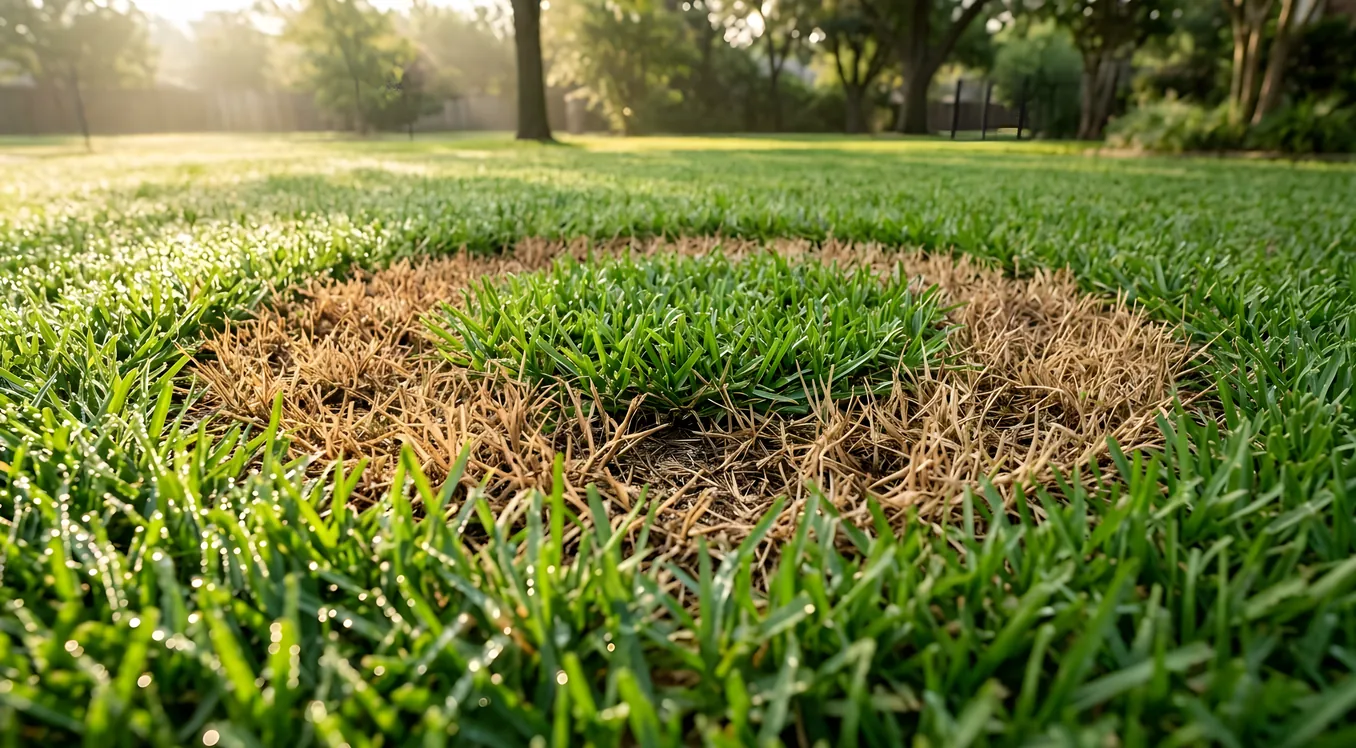
What is brown patch in St. Augustine grass and how do I treat it? Brown patch is a fungal disease caused by Rhizoctonia solani, and it usually shows up as grass approaches or emerges from dormancy in fall, winter, or spring. Evening temperatures below 68°F and rising rainfall set it off, and it produces patches that can grow to several yards across. It spreads fastest between 75°F and 85°F when conditions are wet, and it generally eases once air temperatures climb above 90°F. Its circular or semi-circular shape sets it apart from chinch bug damage, which develops as irregular dead patches instead. Two cultural habits reduce it: watering only as needed early in the day, and avoiding heavy fertilization in spring and fall. For the other lawn services explained on this site, including watering, fertilizing, and pest control, see the services overview.
What Brown Patch Looks Like
Brown patch is caused by the fungus Rhizoctonia solani, a soil-borne pathogen that attacks the grass blade near the soil line rather than the root system. Affected areas start small and expand into patches that can reach several yards in diameter, with a shape that tends toward circular or irregular as the patch grows outward from its original center. It most often appears as St. Augustinegrass and other North Texas lawns approach dormancy in the fall or begin to green up in spring, when the turf is already under some stress from temperature swings and is slower to outgrow damage than it would be during peak summer growth. A homeowner who spots a roughly round dead or thinning area for the first time, without a clear insect or drought cause, is looking at a pattern consistent with this disease.
When Brown Patch Shows Up on North Texas Lawns
Brown patch develops in fall, winter, and spring, tied closely to evening temperatures that drop below 68°F alongside rainfall that typically increases during those seasons. The disease spreads fastest when air temperatures sit between 75°F and 85°F and wet conditions are present, whether from rain or irrigation left running too long. It generally subsides once air temperatures climb above 90°F, which is part of why it reads as a cool-season problem rather than a summer one, even though the lawn stress that sets it up can trace back to a hot, dry stretch beforehand. After a hot, dry North Texas summer, cooling September nights and the return of regular rainfall create close to ideal conditions for it, which is why lawns that looked fine in August can show symptoms within a few weeks once fall weather settles in. That timing lines up with the current season: as nights cool and rain becomes more regular, the temperature and moisture conditions AgriLife describes are exactly what starts showing up in North Texas yards.
Brown Patch, Large Patch, and Chinch Bug Damage: Telling Them Apart
Brown patch symptoms occur in a circular or semi-circular pattern, which is the first thing to check against what's showing up in the yard. Chinch bug feeding produces irregular-shaped dead or dying areas instead, and that damage normally doesn't become visible until southern chinch bug populations reach roughly 20-25 bugs per square foot in the affected area, since a small population does too little visible harm to notice. Large patch is often confused with brown patch because both appear on St. Augustinegrass and both can produce rounded dead areas. According to AggieTurf's Large Patch publication, the same fungus, Rhizoctonia solani, causes both diseases. Over-irrigation and applying nitrogen fertilizer in early fall can both make large patch worse, so the same watering and fertilizing habits that help with brown patch tend to help there too.
A quick way to sort the three: a rounded patch points to a fungal disease, an irregular ragged patch points to an insect, and a patch that keeps recurring in the same low, wet spot every fall leans toward large patch rather than brown patch. None of these patterns is a substitute for a close look at the actual grass, but they narrow down where to start.
Identifying Your Grass Type First
Brown patch management can look a little different depending on what grass is actually growing in the yard, since St. Augustinegrass and Bermudagrass respond to watering and fertilizing on somewhat different schedules and carry different nitrogen limits. Before deciding how to respond to a patch, it helps to identify your grass type and confirm what's on the ground, rather than assuming based on what a neighboring yard has. The site's grass-types guide walks through the characteristics AgriLife documents for St. Augustinegrass and Bermudagrass, which makes it easier to match the right watering and fertilizing timing to the right lawn before adjusting a routine in response to brown patch.
Watering and Fertilizing to Prevent Brown Patch
The two clearest prevention habits both come straight from AgriLife's guidance. Water only as needed, and do it early in the day rather than in the evening, so the grass has time to dry before nightfall. Watering late in the day keeps grass wet overnight, right when brown patch spreads fastest, since the fungus favors the combination of warm temperatures and prolonged moisture on the blade. The second habit is avoiding over-fertilization in spring and fall, one of the two habits AgriLife names for reducing brown patch pressure. Nitrogen pushes tender new growth at exactly the time of year the disease is most active, so restraint during those two seasons matters more than restraint in summer.
For general nitrogen discipline, AgriLife's Bermudagrass management guidance caps nitrogen at 0.5 to 1 pound per 1,000 square feet per application, with a typical plan using one to four applications across the growing season. St. Augustinegrass guidance similarly recommends 0.5 to 1 pound of nitrogen per 1,000 square feet per application, one to four times during the growing season, while capping total nitrogen at 4 pounds per 1,000 square feet per year, with the last application made 4-6 weeks before the first historic frost. These are two separate figures for two separate grasses, not one blended number, and confirming grass type first makes it possible to apply the right one. For the fuller nitrogen-rate and timing guidance behind these caps, see how nitrogen timing affects your lawn.
Skip a heavy fall feeding if brown patch has shown up on the property before. The same fungus that causes brown patch is also linked to worse large patch outbreaks when nitrogen goes down in early fall.
Managing an Active Outbreak
The first response to an active outbreak is the same as prevention: correct the watering schedule so grass dries during the day, and avoid over-fertilizing in spring and fall. These two cultural controls address the conditions that let brown patch spread in the first place, and they cost nothing beyond adjusting an existing routine.
Beyond cultural controls, licensed pesticide applicators can offer fungicide treatment as an additional option for an active outbreak. Under Texas Department of Agriculture rules, anyone applying pesticide, including fungicide, to lawns for hire needs a TDA license; an applicator handling fertilizer alone does not need that license. To find a business that offers fungicide treatment, compare local lawn care companies in the homepage directory and ask each one directly whether it treats lawn disease.
A quick pattern check tells you which page to read next. A circular or semi-circular patch points to brown patch. An irregular, ragged dead patch points to chinch bugs instead.
Brown Patch Through the North Texas Season
Brown patch shows up in fall, winter, and spring, spreading fastest between 75°F and 85°F with wet conditions and easing once temperatures pass 90°F. That window overlaps with a lot of other lawn care timing: fertilization schedules, pre-emergent applications, and pest windows for fire ants, chinch bugs, grubs, and armyworms all interact across the same calendar, and getting one piece out of sequence can make another problem worse. The full North Texas lawn care calendar lays out how these pieces line up across the year, month by month, for a homeowner trying to plan beyond just this one patch of grass.
Frequently Asked Questions
What causes brown patch in St. Augustine grass?
A fungus called Rhizoctonia solani. It typically shows up as grass approaches or emerges from dormancy, when evening temperatures drop below 68°F and rainfall increases, conditions common to North Texas fall, winter, and spring.
How do I treat brown patch in St. Augustine grass?
Start with two cultural habits: water only as needed and early in the day so the grass dries quickly, and avoid over-fertilizing in spring and fall. Beyond that, licensed pesticide applicators can offer fungicide treatment as part of a lawn program.
What does brown patch look like, and how is it different from chinch bug damage?
Brown patch forms a circular or semi-circular pattern that can grow to several yards across. Chinch bug feeding instead produces irregular-shaped dead or dying patches, which usually don't become noticeable until populations reach roughly 20-25 bugs per square foot.
When does brown patch usually show up in North Texas?
Fall, winter, and spring, as grass enters or comes out of dormancy. It spreads fastest between 75°F and 85°F with wet conditions present, and it generally eases once temperatures climb above 90°F.
Can overwatering or overfertilizing cause brown patch?
Both make it worse. Watering in the evening instead of early in the day leaves grass wet longer, and over-fertilizing in spring or fall are the two management mistakes most closely tied to a worsening outbreak.